
Marketplaces charge VAT at the point of sale when an overseas seller ships goods worth £135 or less to a UK buyer, or sells goods already located in the UK. UK-established sellers usually stay liable themselves. Either way, you still keep the records, register where required and reconcile platform reports with your VAT return, as we explain for multi-platform ecommerce sellers.
Key Takeaways
Marketplaces automatically determine VAT liability based on seller location, stock presence, and consignment value, affecting who charges or accounts for VAT in the UK.
| Point | Details |
|---|---|
| Seller classification depends on signals | Marketplaces use data like Companies House registration, bank details, and IP address to classify sellers, influencing VAT responsibilities. |
| Location of stock is key | If stock is stored in the UK during a sale, the marketplace is responsible for VAT, regardless of seller origin. |
| The £135 threshold matters | Imported goods valued at or below £135 sold through marketplaces require the platform to handle VAT; above that, import rules apply. |
| Seller compliance is essential | Sellers must keep accurate import documentation, verify records regularly, and reconcile marketplace reports with their VAT returns. |
| eAccounts recommends proactive checks | We advise verifying your profile details, stock locations, import records, and reports quarterly to ensure VAT compliance. |
Table of Contents
- How do marketplaces decide who is liable for VAT?
- The core rules: the £135 rule, goods in the UK and deemed supply
- What you must do: seller obligations and import compliance with FBA
- Your checklist: what to check today in your marketplace accounts
- Accounting and reconciliation: marketplace-collected VAT in your return and Xero
- What has changed recently, and what is the June 2026 HMRC consultation?
- How accountants keep marketplace VAT under control
- How can we help with VAT, import compliance and Xero?
- FAQ
- Sources
How do marketplaces decide who is liable for VAT?
Marketplaces do not ask you to explain your tax position. They run automated checks and treat you according to the answer those checks produce. Gov says marketplaces test where a seller is established using signals such as Companies House registration, VAT number matching, payment details and the IP address of the device used on the account.
If those signals disagree, the platform may treat you as an overseas seller. That matters because the liability rules differ sharply between overseas and UK-established sellers.
What evidence does a marketplace look at?
The checks usually draw on a handful of data points:
- Your Companies House registration, where you trade as a limited company
- The VAT number and business name on your account
- The bank account that receives your payouts
- The IP address you log in from
- The address listed on your seller profile
A mismatch between any of these and your official records can trigger reclassification. A UK limited company with a payout account in another country, for instance, can look overseas on paper.
Why does the location of your stock matter?
Where the goods physically sit at the moment of sale is one of the strongest tests. Under the same GOV.UK guidance, a marketplace is liable for VAT on goods of any value that are located in the UK at the point of sale and sold by an overseas business. If an overseas seller stores stock in a UK fulfilment centre, the marketplace becomes responsible for the VAT on those sales, however large the order.
How does the £135 rule work?
The second test is the consignment. GOV.UK guidance on overseas goods sets a £135 threshold on the intrinsic value of the goods in a consignment, which means the value of the goods themselves, excluding shipping, insurance and any duty. Imported consignments at or below £135 sold through a marketplace are the marketplace’s VAT responsibility. Above £135, the standard import rules apply and the seller or importer deals with VAT at the border.
What happens when the automated check gets it wrong?
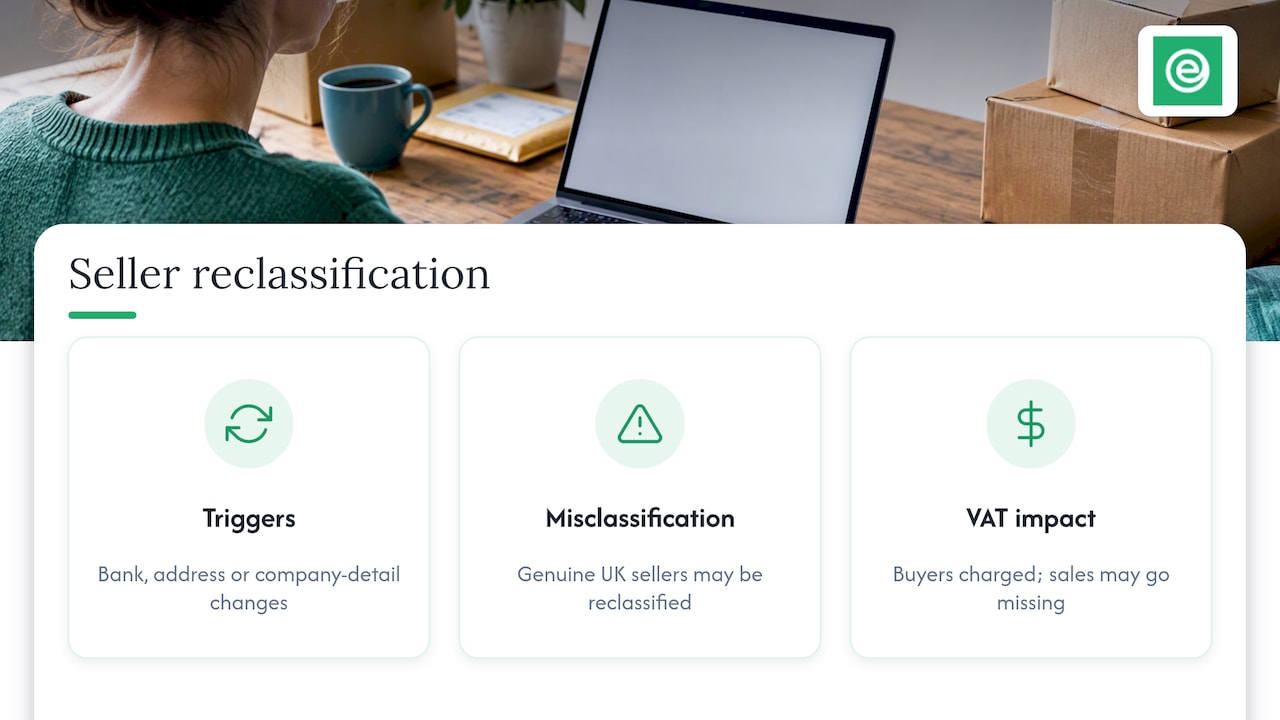
Platforms sometimes misclassify genuine UK sellers, usually because of the data mismatches above. Reclassification can also follow a change of business structure, a new bank account or a move to a different fulfilment model. The result is VAT charged to your buyers when you did not expect it, or your own return missing sales that the marketplace has treated differently.
Pro Tip: Compare your seller profile against your Companies House record and VAT certificate every quarter, and again after any change of bank, address or company details.
The core rules: the £135 rule, goods in the UK and deemed supply
Three rules cover most marketplace VAT questions. Each one applies to a specific situation, so match your sales to the rule rather than assuming one treatment fits every listing.
Rule one: consignments of £135 or less
GOV.UK guidance on charging VAT through a marketplace says that for a consignment with an intrinsic value of £135 or less sold to a UK customer, the marketplace charges and accounts for the UK VAT. The exception is a VAT-registered business buyer who supplies a valid UK VAT number. In that case the marketplace does not charge VAT and the buyer accounts for it through the reverse charge.
Rule two: goods already in the UK
When an overseas seller’s goods are in the UK at the point of sale, the marketplace is liable for the VAT on sales of any value. A UK-established seller in the same position generally remains liable for its own VAT unless the marketplace is the deemed supplier under the rules.
Rule three: deemed supply
When the marketplace is responsible for VAT, the transaction is split in two for VAT purposes. The same guidance explains that the seller’s sale to the marketplace is often treated as a zero-rated supply, and the marketplace then makes the taxable sale to the customer. The seller does not charge VAT on that first leg, but the transaction still belongs in the seller’s records and VAT return.
How the rules apply: worked examples
These examples use illustrative figures only.
- Overseas seller, small parcel. A seller based outside the UK ships a low-value phone case from abroad to a UK buyer. The consignment is under £135, so the marketplace charges the VAT at checkout and accounts for it.
- Overseas seller, stock in the UK. The same seller stores bulk stock in a UK fulfilment centre and sells an item from it. The goods are in the UK at the point of sale, so the marketplace is liable regardless of value.
- Business buyer with a VAT number. A UK business buys a £90 item for resale and gives a valid VAT number. The marketplace does not charge VAT, and the buyer applies the reverse charge.
- UK-established seller, stock in the UK. You are a UK business shipping your own stock from a UK address. You normally charge and account for VAT yourself.
What the rules mean for you:
- Check whether you are classed as UK-established or overseas
- Check where the stock sits when the order is placed
- Check the value of the consignment, not the value of the whole basket
- Check whether the buyer supplied a VAT number
What you must do: seller obligations and import compliance with FBA
Marketplace collection does not remove your own duties. Registration, import paperwork and records stay with you.
When do you need to register for VAT?
The UK registration threshold is £90,000, according to HMRC’s consultation page. The same source notes that an overseas seller storing goods in the UK, for example through Fulfilment by Amazon, must register immediately whatever their turnover. Our guide to the £90,000 threshold and the 30-day registration rules covers the timing for UK sole traders, and our walkthrough on how to get a VAT number for Amazon covers the application steps.
What import compliance do you need for fulfilment?
Amazon’s international trade compliance guide states that when you source products from overseas for Fulfilment by Amazon, the importer of record is legally responsible for customs clearance. Amazon will not act as importer of record. You need a UK VAT registration number and a UK EORI before the goods reach the border.
In practice that means:
- Hold a UK EORI number before shipping
- Use the correct commodity (HS) code for every product
- Declare the right customs value
- Agree delivery terms that make clear who pays import VAT and duty, where required
What are the IEN and FHDDS rules?
Each customs import produces an Import Entry Number (IEN). Under the Fulfilment House Due Diligence Scheme, Amazon’s guidance says sellers must enter the IEN into Seller Central. Check Amazon’s guidance for the applicable requirements. That number links the physical shipment to the customs declaration, which makes it the first thing an auditor looks for.
Our accounting tips for Amazon FBA sellers show how to log these numbers alongside shipment records.
What if compliance lapses?
Missing paperwork can lead to listings being removed, marketplace enforcement action and HMRC enquiries into your returns. Gaps in IEN records are especially awkward, because they are hard to rebuild months later.
Pro Tip: Create one folder per inbound shipment holding the supplier invoice, customs entry, IEN and Seller Central shipment ID, and file it the day the stock is received.
Your checklist: what to check today in your marketplace accounts
Work through these in order. Each step catches a problem the next one would otherwise inherit.
- Match your profile to official records. Check that your business name, VAT number and bank details on the marketplace agree with Companies House and HMRC.
- Confirm inventory locations. Make sure your listings and inventory settings reflect where goods really are when the order is placed.
- Log your import paperwork. Keep your EORI, IENs, customs entries and shipment IDs together, and pair each IEN with its Seller Central entry.
- Check your reports. Confirm the marketplace reports show VAT charged on each sale, and that the platform holds your VAT number for business-to-business sales.
- Automate your feeds. Connect marketplace data to your accounting system and flag marketplace-collected transactions so they are reconciled separately.
Pro Tip: Run this checklist at the end of every VAT quarter, before you prepare the return, not after.
Accounting and reconciliation: marketplace-collected VAT in your return and Xero
The bookkeeping is where marketplace VAT usually goes wrong. The marketplace sees one version of your sales, your ledger shows another, and the VAT return needs both to agree.
How do deemed supplies appear in your books?
When the marketplace collects the VAT, your report will show the sale as zero-rated, because it is treated as a supply to the marketplace. The customer, meanwhile, has paid VAT to the platform. GOV.UK guidance is clear that you remain responsible for accurate returns and must reconcile the marketplace’s sales reports with your own records, even when the platform charges the VAT.
How should you reconcile?
- Keep separate control accounts for marketplace-collected and seller-liable sales
- Map each marketplace report column (sales, fees, VAT, refunds) to a specific Xero field
- Run a variance check between the marketplace totals and your nominal ledger each period
- Record business buyers who supplied a VAT number as reverse-charge sales, not standard-rated ones
Why automate?
Tools such as Xero and Link My Books reduce manual keying, which is where most reconciliation errors begin. Automated feeds also leave an audit trail, so you can show how a marketplace figure became a line on your return. Our article on how online accountants handle VAT for sellers walks through this workflow in more detail.
Pro Tip: Reconcile the marketplace’s VAT figure to your ledger before the return is prepared, because a difference found at filing is far harder to trace.
What has changed recently, and what is the June 2026 HMRC consultation?
HMRC’s June 2026 consultation explores extending marketplace liability to certain domestic sales, to combat VAT non-compliance. The accompanying factsheet says the reforms aim to tackle non-compliance that benefits non-compliant sellers. If the changes go ahead, marketplaces could collect VAT on more transactions than they do now, so your reports and ledgers would need to separate more sales.
Steps to take now:
- Subscribe to GOV.UK updates on online marketplace liability
- Read compliance notices from each platform you use
- Ask your accountant how any change would alter your reconciliation
How accountants keep marketplace VAT under control
In our work with sellers, the same fixes recur: a dedicated accountant splits marketplace-collected and seller-liable transactions, ties each IEN to its shipment, corrects establishment evidence on the platform and automates reconciliations. If the admin or the risk is growing, professional support pays for itself in avoided errors.
— Kris
How can we help with VAT, import compliance and Xero?
We are Xero Platinum Partner accountants in Swansea, and every client gets a dedicated accountant. For marketplace sellers that means VAT returns and VAT registration, Xero online accounting with marketplace feeds set up properly, IOSS support, and ongoing bookkeeping that keeps IEN and shipment records ready for an HMRC enquiry.

Our plans start from £29 + VAT a month. If you want to know which of your sales the marketplace treats as its own and which stay yours, book a consultation and we will go through your reports with you.
FAQ
Do I need to be VAT registered to sell on Etsy?
Not automatically. You must register once your taxable turnover passes the £90,000 threshold, set out in HMRC’s consultation page. Some sellers register earlier voluntarily to reclaim VAT on costs.
Are Amazon fees vatable?
Amazon’s seller fees are generally charged with VAT added, and VAT-registered sellers can normally reclaim it as input tax. Check your fee invoices, and make sure the VAT shown is entered in your records so it reaches your return.
Can I sell on Amazon without being a business?
Occasional personal sales can be treated differently from trading, but regular selling for profit counts as a business. If you sell regularly, you should register as self-employed, keep records and review your VAT position.
Why does the marketplace sometimes treat a UK seller as overseas?
It usually happens when profile data does not match official records. The platform’s checks, described in GOV.UK establishment guidance, include Companies House details, VAT number, payment details and IP address, so aligning those removes most mismatches.