If your side hustle brings in £1,000 or less in gross income during a tax year, you normally pay no tax on it and don’t need to tell HMRC. Go over £1,000 and you must register for Self Assessment, then choose between deducting your real costs or deducting the £1,000 allowance. If you sell on several marketplaces, our All-inclusive online seller accounting page shows how we handle the bookkeeping and VAT side for you.
Key takeaways
- The £1,000 trading allowance applies to gross income (before expenses), and it is one allowance across all your side hustles, not one per hustle.
- Above £1,000 you must register and file a return. You then deduct either the allowance or your actual expenses, never both.
- There is no special side hustle tax rate. Profit is taxed at your normal Income Tax rate alongside your other income.
- Staying under £1,000 can still leave reasons to register, such as paying voluntary National Insurance.
- Growing sellers should keep proper records from day one. Making Tax Digital thresholds are falling over the next two years.
Table of Contents
- What the trading allowance actually is
- Who this covers: common side hustles
- One allowance, however many hustles you run
- The key tests: under or over £1,000
- Allowance or actual expenses: which is better?
- How the profit is taxed
- When you should register even under £1,000
- Common mistakes with the trading allowance
- Beyond the allowance: Making Tax Digital and VAT
- Our perspective
- When it’s worth getting help
- A simple yearly checklist
- FAQ
- Sources
What the trading allowance actually is
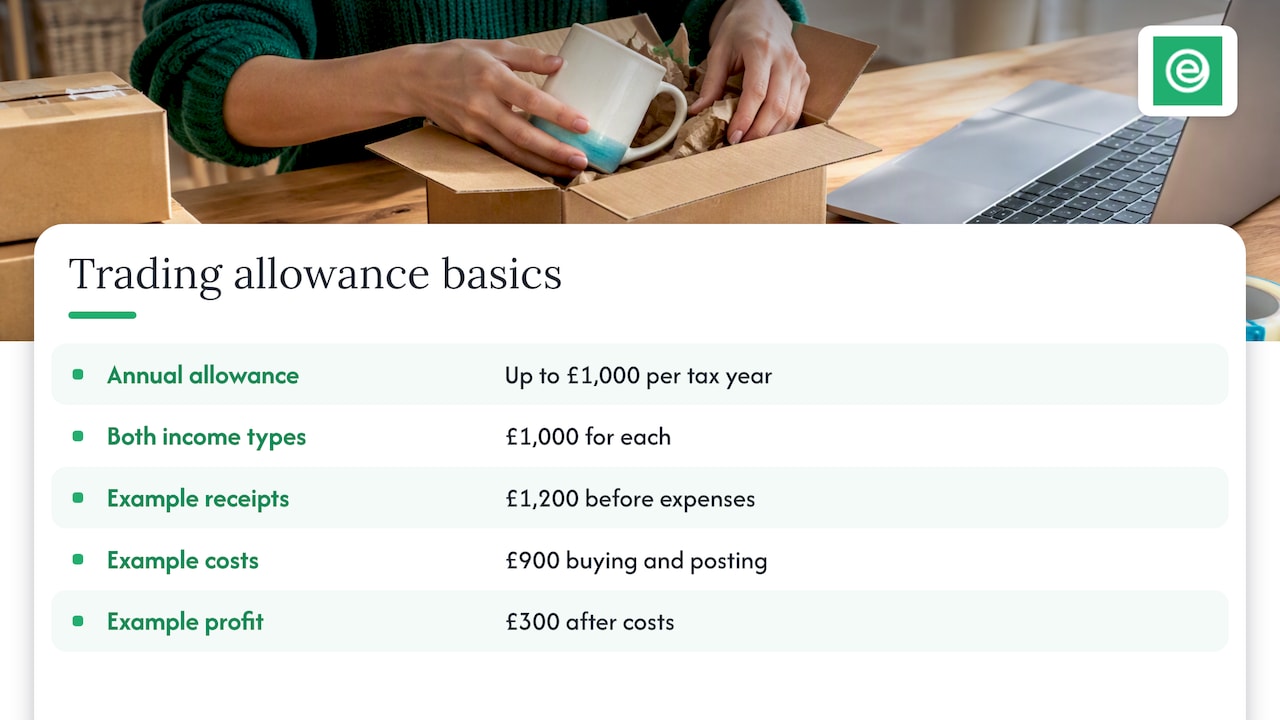
The trading allowance is a tax exemption introduced on 6 April 2017. GOV.UK says you can get up to £1,000 each tax year for property or trading income, and if you have both types of income you get a £1,000 allowance for each.
Two words matter in that rule: gross and trading.
Gross means the money coming in before you take anything off. If you sell £1,200 of items and spent £900 buying and posting them, your profit is £300, but for the allowance test your income is £1,200. HMRC’s own help sheet describes it as receipts of £1,000 or less being exempt, and that is a test on receipts, not profit.
Trading covers self-employment and certain miscellaneous income: casual services, freelance gigs, reselling goods you bought to sell, making and selling crafts. The tax year runs from 6 April to 5 April, so the clock resets each April.
It is an administrative simplification, not a new tax bracket and not a blanket “tax-free” status. If you are under the limit you don’t have to report that income, and you don’t have to track the small costs behind it.
Who this covers: common side hustles
The allowance suits people who earn a little on the side:
- Occasional freelance work such as design, writing or tutoring
- Selling handmade items at markets or online
- Reselling items you bought with the intention of selling at a profit
- Dog walking, gardening, odd jobs for neighbours
- Hiring out equipment you own
It does not cover everything. Selling your own unwanted belongings, such as clearing out your wardrobe, is generally not trading in the first place. We cover that distinction, and what marketplace reporting means, in our guide to declaring extra income to HMRC and in eBay seller tax: reporting is not a tax bill. For Vinted, eBay and Etsy sellers, see when HMRC finds out about your Vinted, eBay and Etsy sales.
The allowance also cannot be used for income from a connected party. HMRC’s help sheet notes you can’t use it where the income is from an employer or a family member’s business, for instance.
One allowance, however many hustles you run
This is where people trip up. The £1,000 is a combined limit across all your self-employment and miscellaneous income in the tax year. HMRC’s self-employment notes are the place to check how this is treated on the return.
Say you sell second-hand clothes online and do occasional freelance proofreading:
| Income stream | Gross income in the year |
|---|---|
| Online reselling | £600 |
| Proofreading | £550 |
| Total | £1,150 |
Each stream is under £1,000, but the total is £1,150, so you are over the limit. You can’t claim £1,000 against each. The only separate allowances are for the two types of income: trading and property each get their own £1,000.
The key tests: under or over £1,000
Under £1,000 gross
You typically don’t need to notify HMRC or register for Self Assessment, and the income is exempt. GOV.UK’s Tax Confident pages put it simply: most people can earn £1,000 from side hustles before telling HMRC.
There are exceptions, covered below, such as wanting to pay voluntary National Insurance.
Over £1,000 gross
GOV.UK states you must send a tax return if you were self-employed as a sole trader and earned more than £1,000 before deductions. You register as a sole trader by registering for Self Assessment.
The registration deadline is 5 October after the end of the tax year in which you went over. For 2025/26 income that was 5 October 2026. For income in the current 2026/27 year, the date is 5 October 2027. The return for 2025/26 and any tax owed are due by 31 January 2027, as HMRC’s self-employment notes also reference.
If you have missed a registration deadline, don’t wait. Register as soon as you realise, and speak to an accountant if you are unsure what you owe.
Allowance or actual expenses: which is better?
Once you are over £1,000 you have a choice. HMRC’s help sheet explains that individuals with receipts above £1,000 can elect to deduct the allowance instead of actual expenses.
The two methods:
- Method A (allowance): taxable profit = gross income minus £1,000. No other expenses or capital allowances.
- Method B (actual expenses): taxable profit = gross income minus your real, allowable business costs.
Pick whichever gives the lower profit. The rule of thumb is simple: if your real costs are above £1,000, claim them. If they are below, the allowance usually wins.
Worked example
Amira makes candles and sells £3,500 in the tax year (gross).
| Allowance | Actual expenses | |
|---|---|---|
| Gross income | £3,500 | £3,500 |
| Deduction | £1,000 | £1,400 (wax, jars, postage, fees) |
| Taxable profit | £2,500 | £2,100 |
Her real costs of £1,400 beat the allowance, so she is better off claiming expenses. If her costs had been £600, the allowance would have given her the better result: £2,500 rather than £2,900.
The figures are illustrative and not tax advice for your case. What you pay on the profit depends on your total income, as the next section explains.
Why records matter even when you take the allowance
You can only compare the two methods if you know your actual costs. Growing sellers with stock, packaging, platform fees and equipment often find actual costs overtake £1,000 quickly. A tidy set of records means you can run the comparison each year rather than guess. Our sole trader bookkeeping guide explains what to keep and for how long.
How the profit is taxed
There is no side hustle tax rate. Taxable profit is added to your other income, such as a salary, and taxed at the Income Tax rates that apply to your total. That is why the same £2,000 profit costs one person less than another.
This also answers a common search, “do you get taxed 40% on a second job?” You aren’t taxed at a flat 40% because of a side hustle. Only the part of your total income that falls into a higher band is taxed at the higher rate. Check the current bands and thresholds on GOV.UK, as they can change, and ask an accountant if your combined income is near a band edge.
When you should register even under £1,000
Staying under the limit doesn’t always mean you can ignore HMRC. You may still want or need to register if:
- You want to pay Class 2 National Insurance voluntarily to protect your State Pension record.
- You need to prove self-employment for something like Tax-Free Childcare or Maternity Allowance.
- You want to claim a loss against other income, which the allowance wouldn’t let you do.
GOV.UK lists the circumstances in its guidance on who must send a tax return. If you are unsure whether any apply to you, a short conversation with an accountant before 5 October of the following year is cheaper than a penalty.
Common mistakes with the trading allowance
- Testing profit instead of gross income. £1,200 of sales with £900 of costs is over the limit, even though profit is only £300.
- Claiming £1,000 per hustle. The limit is shared.
- Mixing both methods. You can’t take the allowance and also deduct costs.
- Assuming “tax-free” means “invisible”. Over £1,000 you register, even if the final bill ends up small.
- Forgetting the connected-party rule. Income from your employer or a family member’s business doesn’t qualify.
- Not keeping records until you outgrow the allowance. By then you can’t reconstruct your costs.
Beyond the allowance: Making Tax Digital and VAT
Many side hustles stop being small. Two rule sets arrive quickly.
Making Tax Digital for Income Tax
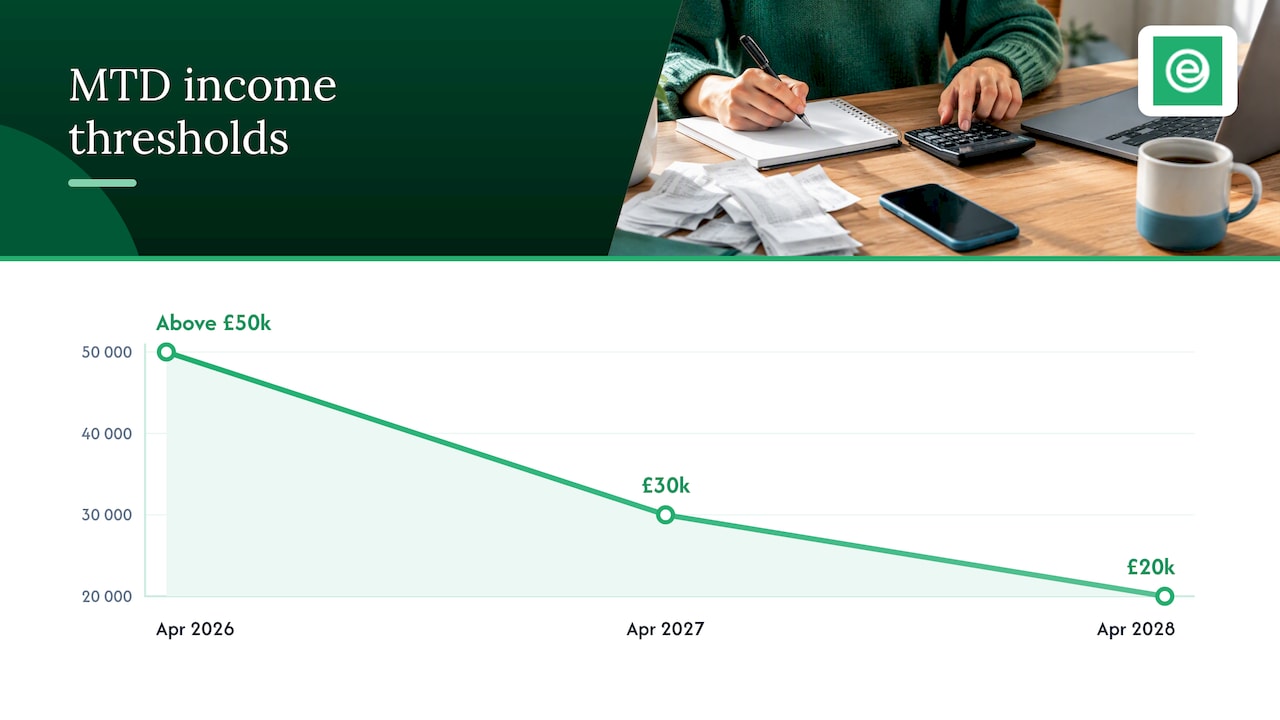
From 6 April 2026, sole traders with qualifying income above £50,000 from self-employment or property must use MTD-compliant software and send quarterly updates. The threshold is scheduled to fall to £30,000 in April 2027 and £20,000 in April 2028. Qualifying income is gross turnover, so the same “before expenses” logic as the trading allowance applies, as HMRC explains when it describes how to work out qualifying income.
Using the trading allowance to simplify your profit calculation doesn’t exempt you from digital record-keeping once you meet the threshold. Our MTD for Income Tax practical guide and the sole trader deadline walkthrough set out what to do and when.
VAT
The trading allowance has nothing to do with VAT. VAT registration depends on your taxable turnover against the VAT threshold, currently £90,000, and it is a separate decision from Income Tax. A hobby-sized seller is unlikely to be near it, but a fast-growing online shop can be. If you are approaching it, see our VAT registration service and the frequently asked VAT questions.
Our perspective
We work with UK online sellers every day, and the pattern is consistent: most people who come to us didn’t set out to run a business. They sold a few things, it worked, and one day the sales were well above £1,000.
The allowance is a good rule, and we are glad it exists. But we think it works best as a decision you make with figures in front of you, not a default. The sellers who struggle are the ones who have no records from their first months, then try to rebuild a year of postage, fees and stock from bank statements.
Our advice is practical:
- Open a separate bank account for the hustle from day one, even if you stay under £1,000.
- Record sales and costs monthly in simple software. Our team is a Xero Platinum Partner, and we pair each client with a dedicated accountant, so someone checks the numbers with you.
- At the end of the year, run both methods and take the better one.
- If you sell on marketplaces, remember that platforms may report your sales to HMRC. Accurate records mean you can reconcile what they report to what you earned.
We would rather you register early and have a calm January than hit a deadline you didn’t know existed.
— Kris
When it’s worth getting help
If you are a sole trader whose side hustle has grown, our sole trader accountants work from £29 + VAT a month, with a dedicated accountant, Xero set-up and Self Assessment support. For sellers on Amazon, Shopify, Etsy or eBay, our All-inclusive plan covers marketplace bookkeeping and VAT returns. If you only need the books tidied first, see our bookkeeping services. You can get a quote and an upfront consultation before committing.
A simple yearly checklist
- In April, note the new tax year and reset your running total of gross trading income.
- Each month, record sales and costs, keeping receipts and platform statements.
- Mid-year, check your running gross total against £1,000.
- If you are over, register for Self Assessment well before 5 October after the tax year ends.
- Compare the allowance with actual expenses, and pick the better method.
- File by 31 January and pay any tax due.
- Check whether MTD for Income Tax will apply to you in the coming years.
FAQ
How much can I earn from a side hustle before paying tax?
You can earn up to £1,000 gross in a tax year from trading and certain miscellaneous income without paying tax on it. That is total income before costs, across all your side hustles. Once you pass £1,000 you need to register for Self Assessment and report it.
Do I need to tell HMRC when I start trading?
Not if your gross trading income stays at £1,000 or less in the tax year. If it goes above, you must register and file a return, with the sole trader registration page showing how. You may also choose to register below £1,000, for example to pay voluntary National Insurance.
I earned £1,002. Do I pay tax on the whole amount?
No, but you must report it. You can’t bring your income under £1,000 by adding expenses, because the test is on gross income. You then choose between deducting the £1,000 allowance, leaving £2 of profit, or deducting your real costs if they are higher.
Do I get taxed 40% on a second job?
No, not as a flat rate. Your side income is added to your other income and taxed at the rates for each band it falls in. Only the portion in a higher band is taxed at the higher rate.
Can I use the allowance and claim expenses together?
No. If you elect to use the allowance you can’t claim other business expenses or capital allowances, so compare both methods before you file.
Sources
- Tax-free allowances on property and trading income, GOV.UK
- HS222 How to calculate your taxable profits (2026), GOV.UK
- Self-employment (full) notes 2026, HMRC
- Self Assessment tax returns: who must send a tax return, GOV.UK
- Register as a sole trader, GOV.UK
- How tax works on extra income and side hustles, Tax Confident
- Find out if and when you need to use Making Tax Digital for Income Tax, GOV.UK
- Work out your qualifying income for Making Tax Digital for Income Tax, GOV.UK